On Sunday 13th June, Lewy and I headed out
to Muriwai beach to test a new kite fishing winch. The weather was overcast with
10 to 15 knots of northeast breeze at ground level.
We decided to fish two kilometres
north of the creek. The new winch was spooled with a 2000 metre 65kg Dropper
Rig. We connected a Nighthawk kite and Skyhook to ensue we had enough pull for
a real test of the hauling capabilities of the winch.
As the kites soared upwards
we connected the dropline and when it was time to stop the reel to connect the
float bottle it became apparent that we had seriously underestimated the wind
at the 200 metre altitude the kites were set to fly at.
The pull was a brutal
10 – 15kgs and we had to pack the five-litre float bottle absolutely full
with wet sand to prevent the kite lifting it off the beach.
Thick low cloud rolled
through obscuring the kites for much of the time and drizzle set in. The wind
was probably 20-30 knots gusting to 35 knots.
Lewy's Secret Weapon
It
was about then Lewy pulled out his secret weapon – a piece of polystyrene
with a heap of 300mm long traces wrapped round it - and a modified hook section.
Lewy then connected the 15-hook section directly to the float bottle.
I was very
surprised that his first trace was only going to be fishing half a metre beneath
the bottle. The whole hook section was only 12 metres long with the gap between
the traces less than half a metre.
This meant that all the hooks except the last
couple would be mid-water and distributed throughout the whole water column.
I was very cynical! After 20 years of kite fishing this beach I was certain
that keeping the hooks hard on the bottom was our best chance of catching good
fish. Lewy was just as certain that his experience with fishing soft baits from
boats led him to believe that the best snapper are mid-water and the mackerel
fillets he was using for bait would be irresistible to them.
I said to Lewy that
I thought we would only get snapper or gurnard on the bottom two hooks and kahawai
on the rest. The first set to 1000 metres offshore into water around eight metres
deep was pretty much as I expected, we caught one fish - a gurnard on the second
to last hook.
Before we set again I asked Lewy if he had a few metres of 65kg line we
could use between the float bottle and hook section to get the hooks hard on
the bottom, but he was adamant that we leave the rig as it was for the next set.
In no time we had the hooks back out and the second set was let to run 1800
metres offshore. The water is at least 12 metres deep this far out so I thought
that if I was going to be eating fish that evening I would have to buy it on
the way home. I didn't believe any hooks would be on the bottom.
The Big Snapper Catch
When we hauled it back an hour later I was amazed at the catch.
After hauling the float in the first six hooks (the ones fishing nearest to the
surface) had caught four big kahawai.
The seventh hook fishing exactly half way
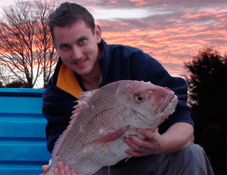
between the surface and the bottom had caught a 10kg snapper and the eight hooks
nearest the seabed had caught another four kahawai.

Lewy grinning from ear to
ear had a well deserved “I
told you so” look written all over his face.
What Is Such A Big Snapper Doing So far Off The Bottom?
It’s a well-known fact
that big snapper often under congregate under schools of feeding kahawai to feed
on the scraps.
What we didn’t know was whether the kahawai school and big
snapper approached our gear at 1800 metres offshore and the big snapper catch
was a fluke, or if we caught the kahawai in close and towed them out to the big
snapper which decided to investigate the commotion and mistook the bait for feeding
fallout from the kahawai. Sort of using the live kahawai as teasers I suppose.
If the latter is the case then stalling the gear for a few minutes 300 to
400 metres out in the hope of picking up a few kahawai may be an advantage for
those targeting big snapper further out.
For those with dropper rigs who wish
to test mid-water setting I would recommend connecting the hook section to the
float bottle and put one weight on after six or seven traces and another just
before the last hook.
This way half the hooks will be on the bottom and wherever
the fish are in the water column you will have a good chance of catching them.
With only 6 weeks to go before the huge snapper turn up again on the west
coast, it’s time to get your gear together and get out there! Although
it was drizzling with rain on the day, the conditions were actually quite comfortable
and the balmy winter weather we’ve had makes us think that perhaps the
huge snapper never left!
|