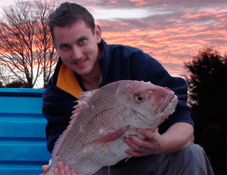
When fishing from a boat in shallow or clear water, snapper can be extremely shy and elusive throughout much of the day, particularly if it is bright and sunny.
Anchor chains rattling, warp vibrations, boat engine noise, fishing line vibration, depth sounder pulses plus the multitude of other common boat noises can scare off all but the smallest snapper.
We believe the reason longlines are so productive for catching snapper is because a longline is set and left to quietly fish while the boat moves away to do other activities, this is why good fish will often be taken on a longline when all else fails
to catch them.
Read our newsletter archive to see what our customers have been catching or see the pictures of fish submitted for our photo contest.
Paul's Fishing Kites use the running clip longline system on their longlines which further enhances the productivity of longling, this system is around twice as efficient as the earlier fixed trace system and actively
sets the hook into the fish.
The fish can run along the mainline until the clip strikes a stopper, thus setting the hook securely into the fish.
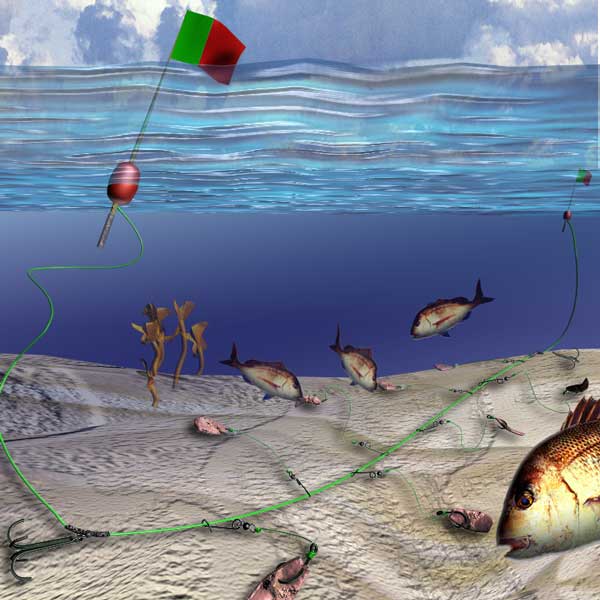
To further enhance your snapper catch Paul's Fishing Kites boat longlines are supplied with the new Target Snapper Hooks. These extremely sharp re-curve hooks are fitted with a wire appendage. This appendage will
reduce the numbers of small snapper caught, reduce gut hooking to less than 1% and increase your catch of larger snapper.
We snell the traces to the hooks rather than tying them on. This increases your catch rate by as much as 20%. Snelling has several advantages over tying.
It applies a spring type effect on the hook which makes it near impossible for the fish to spit the hook out, and snelling is not really a knot, it's more like a whipping or binding so your trace will retain its full breaking strain.
Setting the Gear
It is usually a waste of time setting over slack water so always set your longline when the tide is running and will continue moving for the duration of the set.
First bait the traces, fresh bait is always best, the traces on the trace rack can be baited in place.
When longlining from boats or kayaks, sets over clear bottom, parallel to rocky outcrops or coastline can often yield good fish even when the water is clear.
For those longlining from small boats and kayaks, a 10 inch handspool with a 25 hook pre-stoppered hook section and two droppers wound on keeps things compact and very easy to handle.
On larger boats a longline wound onto a 3:1 ratio geared beach reel fitted with an aluminum pipe around half a metre long to fit into a rod holder gives greater control when setting or retrieving the gear.
To begin setting, the coastlock clip (attached to the end of the first dropper line and the first clip to come off the reel) is clipped to a marker buoy.
Drop or throw the float over the back of the boat and motor away slowly, (around 500 and 800 revs, or about 4 or 5 knots).
At the other end of the first dropper line is a cord which connects the dropper line to the pre-stoppered hook section. In the centre of this cord a small loop is tied and the first grapple is clipped to the loop and put over the side.
As the grapple hits the water its weight and drag speeds the unwinding of the line from the reel or handspool.
Remove a trace from the rack and attach the seaharvester clip over the mainline between the stoppers then let two stops pass before clipping on the next trace on.
This leaves an empty space between traces on the mainline and prevents the traces from sliding together or touching each other and becoming tangled.
After the 25 traces are connected to the mainline the second grapple is attached to the second cord before the back dropper is allowed to unwind from the reel or handspool.
At the very end of the back dropper you will find another coastlock clip to attach to the other float or marker buoy to.
Clip the last float on and toss it over the back of the boat and leave the line to fish for and hour or so.
Retrieving the Longline
Motor back up to the up rip, or up wind, (whichever is stronger) flag or float.
When you initially pull the flag from the water make sure you check the direction the mainline is laying to prevent running the boat over the mainline, if it is not out to the side or back of the boat release the flag and pick it up again from a different
angle of approach.
The flag or float is then unclipped from the dropper line and stowed back where it came from.
Securely attach the clip back around the reel or handspool. Once the first grapple is up and the line is laying out the side of the boat the motor of the boat can usually be taken out of gear during hauling while you simply drift along while bringing
in the mainline and fish.
If you drift out of line start the motor up and reposition the boat. If the gear snags get the boat right over the top of the line before applying pressure to release it.
As each trace is removed from the mainline they should be stored back on the trace rack ready for the next set.
Regulations
- NZ regulations require your name and phone number be clearly marked on your longline float or marker buoy.
- NZ fishng regulations allow for a maximum of two longlines per boat with a maximum of 25 hooks per longline if there are two or more people on board. Do not use keeper hooks on your longline as these will be counted as fishing hooks and you will be
over the allowable limit and risk prosecution.
Another quality product from:
Paul's Fishing Kites Ltd. 39a Neilson Street, Onehunga, Auckland
Ph/Fax: (09) 634-5005 - E-mail Enquiries Here: |