Tangled traces are a major cause of concern to those using longlines for several reasons.
The worst aspect is that the trace shortens as it wraps around the mainline and the baited hook gets closer and closer to the mainline until eventually, it is laying right on it.
Even small sharks have razor sharp teeth, if one happens to vigorously attack the bait or a fish caught on the tangled trace, chances are it will maul the mainline and bait at the same time and sever the mainline in the process.
While this is frustrating for boat longliners and kite dropper rig fishers, who only lose a few hooks and a bit of their hook section, it is catastrophic for those using kite longlines or electric kontikis.
Mainlines severed by sharks are by far the main cause of kite longline and electric kontiki losses on the west coast and the east coasts of Northland and the South Island.
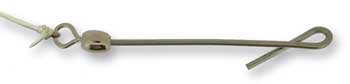
Above :A New Inline Swivel Clip. The new clip reduces tangles and makes any traces that still manage to get tangled much easier to undo. Inline Clip Available
online here
A kite longline fisher is looking at a repair bill of around $150 to $300, depending on the type of kite lost and where the line has been broken. An electric kontiki fisher is facing a cost of $1000 to $1700 just to replace the kontiki, mainline repairs
and trace replacement could add $150 or more to their bill.
While the worst areas for sharks have been identified above, sharks are found everywhere around New Zealand and fishers using kite longlines and electric kontikis are advised to take all precautions wherever they fish using either of these methods.
In addition to the risks associated with tangled traces, fishers also suffer reduced catches of more desirable species like snapper and gurnard and face the frustrating chore of untangling traces to remove the hooks from the mainline.
Tangle Minimising Techniques
A twisted trace occurs as mainline is moving through the water, the trace lays parallel to it, and the hook spins around the mainline faster than the clip rotates. If the hook goes under the trace a knot is formed, otherwise it is just a series of
twists.
Once knotted or twisted the situation quickly deteriorates and multiple knots and twists can form because the swivel on the longline clip ceases to be effective. The faster the mainline moves out, the greater the chance of twists and tangles.
Surf can further compound the issue and kite longline fishers in particular should ensure the gear isn't left stalled in the breakers. A speed of two to three knots, (around walking pace), is the optimum setting speed.
Faster or slower setting speeds can both increase tangles. Because the hook has to pass under the mainline before a tangle can form, several 60 to 240 gram weights clipped between traces, or on the offshore end of the hook section, will keep the mainline
hard on the bottom and reduce risks of tangles.
Weights will improve your catch rates as well. Weights also reduce setting speed so provide a twofold benefit, although electric kontikis will lose some setting distance because of the increased load.
The shape of the bait is also important, strip baits hooked through the middle spin like helicopter blades as they move through the water and increase tangles, while the same bait, hooked through just once at one end, will track straight and help further
reduce tangles.
Risk Minimising Tackle
One of the problems with all longline clips available is that the swivel and clip are two separate components
The swivel swings freely on the clip and can fall into many positions which cause it to be ineffective or actually become part of any tangle or knot.
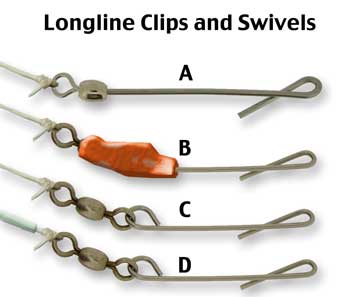
One solution (B) has been to put a short length of heat shrink plastic over the loop of the clip and bottom of the swivel to lock the clip swivel combination in line.
The downside of this is one of the swivel eyes is locked to the barrel and ceases to rotate.
The resulting swivel is only 50% effective and can, in some situations, make matters worse.
Another often tried solution is to encase the trace in a plastic tube and make it too stiff to easily tangle (D).
While a tube will reduce tangles, the downside is the reduction in catch.
The resulting trace is heavy and bulky, both of which increase drag and alert more cautious fish that something is amiss.
Above :
A The new In-line Swivel Longline Clip
B Heat shrink plastic on a Sea Harvester Clip and swivel
C Conventional Sea Harvester Clip and swivel
D Conventional Sea Harvester Clip and swivel with tube on trace
This is not such an issue on the west coast where fish are bigger and less line shy, but it is a real issue on the east coast
and will result in fewer and smaller fish being taken.
Inline Swivel Clip - (See pic A)
A new longline clip which minimises tangles in longlines has recently been released by Paul's Fishing Kites. The most obvious difference between the new clip and all other longline clips is the clip and swivel are a single inline unit.
This removes two degrees of freedom of movement from the clip out of the three possible - the new clip only swivels in the direction it needs to! In other words, the new inline swivel clip only rotates on one axis.
In this respect the Inline Swivel Clip is similar to the tube or heat shrink solutions, but it is much better because it keeps everything in line without the bulk of plastic tube, or the swivel restrictions caused with heat shrink.
These new clips are also heavier gauge stainless wire to prevent clip loss due to stretched clips and the gap is set with a gauge to ensure all are exactly the same. The end of the new clip is forged like the head of a nail and is fitted into a heavy
duty 3/0 crane swivel for strength and durability.
Even when the new clip does tangle it is much easier to undo because the swivel cannot fold over into the tangle and become part of the problem.
What Are The Actual Risks?
Paul's Fishing Kites have been receiving valuable customer feedback from all around New Zealand for 18 years, these estimates are based on that feedback and our own experience.
If you do none of the things in this article and fish a kite longline or kontiki on the west coast around 50 days per year, expect to have a bite off once a year.
If you use large messy baits and/or leave the gear set for more than an hour you could possibly double that.
Losses to sharks on the east coast are less than a quarter of those on the west coast, except the east coasts of Northland and the South Island where it is about half.
Assuming the use of thumb sized baits and keeping every set to under an hour, Paul believes that all the techniques described here can have a cumulative effect of reducing losses to sharks by around 80%. He believes the use of inline clips or their equivalent to reduce tangles are a significant portion of that reduction.
The only 100% shark proof rig at the moment is the kite dropper rig, while hooks and hook sections can be lost to sharks on a dropper rig, all the expensive bits like mainlines and kites are protected by the progressively sacrificial design.
Where to Get Inline Swivel Clips
Inline Swivel Clips are currently only available directly from Paul's Fishing Kites, although wholesale enquires are welcome.